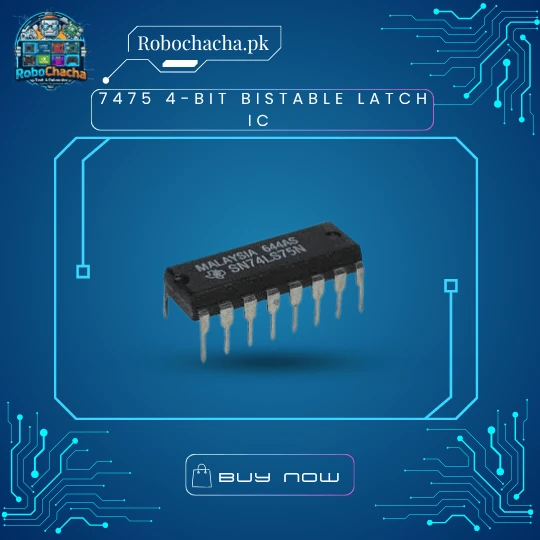
The 7475 Latch IC is a quad bistable transparent latch designed for use as temporary storage for binary information between processing units and input/output or indicator units. It contains four latches organized into two pairs, each with a common Enable (G) input. When the Enable input is High, the Q output follows the D input. When the Enable input goes Low, the data that was present at the input is “latched” and held at the output until the Enable is pulsed again.
Key Features
4-Bit Parallel Storage: Store four independent bits of data simultaneously.
Transparent Operation: Outputs follow inputs in real-time when Enable is active, allowing for high-speed data flow.
Complementary Outputs: Provides both Q and \bar{Q} outputs for each latch, eliminating the need for external inverters.
Standard 16-Pin Layout: Fits perfectly into breadboards and standard IC sockets.
Display Stabilization: The go-to IC for preventing “flicker” on 7-segment displays while a counter is still incrementing.
Technical Specifications
Feature
Specification
Logic Family
74LS (Low-power Schottky) / 74HC
Supply Voltage ($V_{CC}$)
4.75V to 5.25V (Standard 5V)
Package Type
DIP-16 (Dual In-line Package)
Number of Latches
4 (Two pairs with shared Enable)
Output Type
Differential (Q and Q)
Propagation Delay
~15ns to 30ns
Operating Temperature
0°C to 70°C
Latch vs. Flip-Flop: What’s the difference?
Flip-Flop (7474): Only looks at the data during a specific “snap-shot” (the rising or falling edge of a clock).
Latch (7475): Is “open” as long as the Enable pin is High. It is level-triggered, not edge-triggered, making it better for simple data-holding tasks.
Weight
2000 g
Dimensions
15 × 10 × 5 cm
Reviews
There are no reviews yet.
Be the first to review “7475 4-Bit Bistable Latch IC – Quad Transparent Data Latch for Digital Logic & Memory”Cancel Reply



Reviews
There are no reviews yet.