




Overview
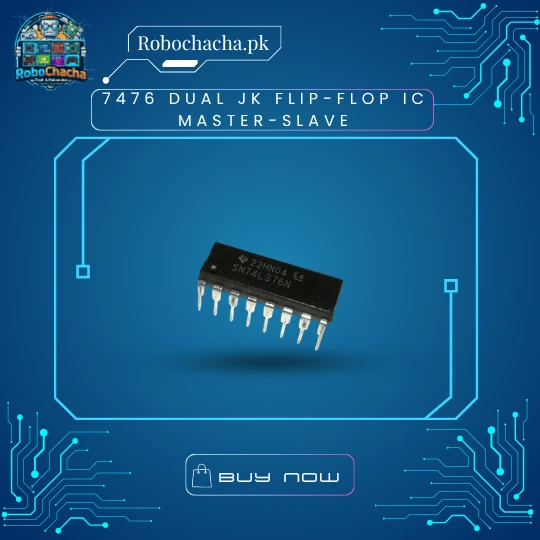
The 7476 JK Flip-Flop IC contains two independent, pulse-triggered Master-Slave flip-flops. Each flip-flop has its own J, K, Clock, Preset, and Clear inputs. The Master-Slave design is highly valued in complex sequential logic because it is less sensitive to “noise” or “glitches” during the clock pulse. Unlike the 7473, this IC includes both Preset (PR) and Clear (CLR) pins for every flip-flop, giving you the ability to force the output to any state (1 or 0) at any time.
Key Features
Master-Slave Reliability: Captures data while the clock is high and changes the output only when the clock transitions, preventing race conditions.
Dual Channel: Two complete, independent JK flip-flops in one 16-pin package.
Preset & Clear Inputs: Independent asynchronous pins allow you to set or reset the flip-flop instantly.
Toggle Capability: Connect J and K to High to create a perfect binary frequency divider.
TTL/CMOS Compatible: Seamlessly integrates with 5V logic systems (Arduino, 8051, PIC).
Technical Specifications
| Feature | Specification |
| Logic Family | 74LS (Low-power Schottky) / 74HC |
| Supply Voltage ($V_{CC}$) | 4.75V to 5.25V (Standard 5V) |
| Package Type | DIP-16 (Dual In-line Package) |
| Triggering Type | Master-Slave (Pulse-Triggered) |
| Clock Frequency | Up to 20MHz (Typical for LS) |
| Power Consumption | Low (approx. 4mW per Flip-Flop) |
| Operating Temp | 0°C to 70°C |
The Master-Slave Advantage
In a standard flip-flop, if the input changes exactly when the clock does, the output can become “unstable” (metastability). The Master-Slave 7476 prevents this by using two internal stages:
Master Stage: “Listens” to the inputs while the clock is High.
Slave Stage: “Updates” the output only when the clock pulse falls.


Reviews
Clear filtersThere are no reviews yet.