
Cash On delivery Availible All Over Pakistan
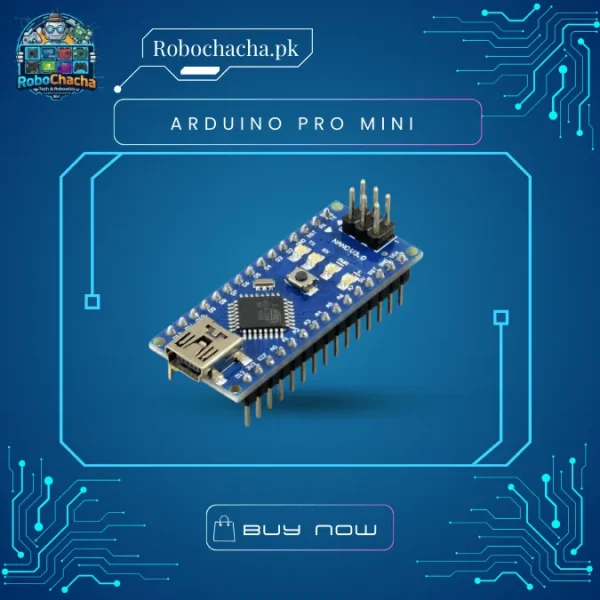
Arduino Nano | ATmega328P | Mini USB Development Board
₨ 700 INC Vat
In stock
Extra Features
- Premium Quality
- Secure Payments
- Satisfaction Guarantee
- Worldwide Shipping
- Money Back Guarantee
The Arduino Nano is a compact, breadboard-friendly microcontroller development board based on the ATmega328P. It offers the same core functionality as the Arduino Uno in a much smaller form factor, making it ideal for space-constrained embedded projects.
With 22 I/O pins, 8 analog inputs, and support for SPI, I²C, and UART communication, the Arduino Nano is widely used in prototyping, robotics, automation, wearable electronics, and educational projects. It is fully compatible with the Arduino IDE and supports programming via Mini-USB.
Key Features
-
Based on ATmega328P AVR microcontroller
-
Compact and breadboard-friendly design
-
Operating frequency: 16 MHz
-
Mini-USB interface for programming and power
-
Multiple digital and analog I/O pins
-
Supports SPI, I²C, and UART
-
Low power consumption
-
Large Arduino community and library support
Detailed Board Specifications
Core & Performance
-
Microcontroller: ATmega328P
-
Architecture: 8-bit AVR
-
Clock Speed: 16 MHz
Memory
-
Flash Memory: 32 KB (2 KB used by bootloader)
-
SRAM: 2 KB
-
EEPROM: 1 KB
Power
-
Operating Voltage: 5 V
-
Input Voltage (VIN): 7 – 12 V
-
Power via Mini-USB or external VIN pin
I/O & Peripherals
-
Digital I/O Pins: 14
-
PWM Pins: 6
-
Analog Input Pins: 8
-
UART: 1
-
SPI: Yes
-
I²C: Yes
Programming & Connectivity
-
Programming Interface: Mini-USB
-
USB-to-Serial Chip: CH340 / FT232 (board dependent)
-
Supported IDE: Arduino IDE
Physical
-
Board Type: Development / Breakout Board
-
Form Factor: Nano
-
USB Connector: Mini-USB
-
Pin Spacing: 2.54 mm
-
Breadboard Compatible: Yes
Typical Applications & Uses
-
Breadboard-based prototyping
-
Robotics and automation projects
-
Wearable electronics
-
Sensor interfacing and data logging
-
DIY electronics and embedded learning
-
Space-constrained microcontroller applications
Why Choose Arduino Nano?
-
Same core functionality as Arduino Uno in smaller size
-
Easy breadboard integration
-
Ideal for compact and portable projects
-
Low power consumption
-
Fully supported by Arduino ecosystem
Package Includes
-
1 × Arduino Nano Development Board
| Weight | 10 g |
|---|---|
| Title | Default Title |
Related products
-
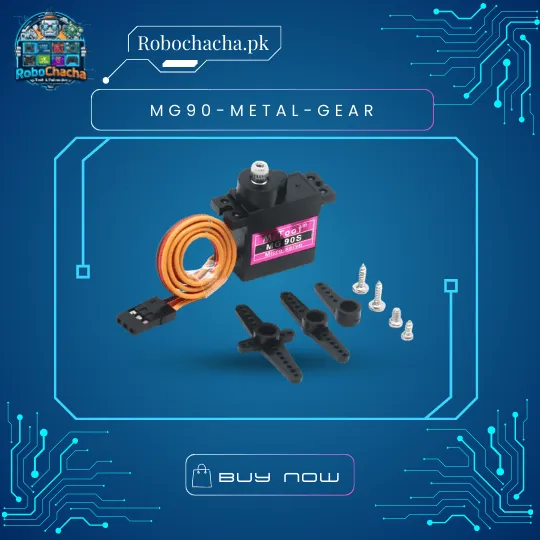
MG90 Metal Gear Micro Servo Motor – High Torque 180 Degree Actuator for Robotics & RC
₨ 580 -

PAM8610 Digital Audio Amplifier Board 15W+15W – Dual Channel Class D 12V Stereo Amp Module
₨ 230 -

USB Digispark ATtiny85 Development Board – Ultra-Compact Arduino Compatible Module
₨ 700 -
SALE 
PAM8403 Mini Audio Amplifier Board 3W+3W Stereo Class D 5V Module for DIY Speakers
Original price was: ₨ 90.₨ 70Current price is: ₨ 70.
Reviews
There are no reviews yet.