




Overview
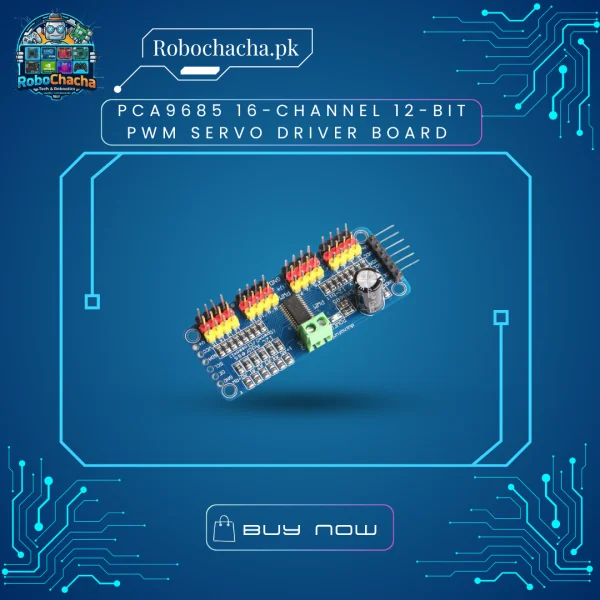
The PCA9685 16-Channel Servo Driver Board is an I2C-controlled PWM driver with a built-in clock. Unlike alternative multi-channel solutions, it is entirely free-running—meaning you don’t need to continuously send it signals from your microcontroller. Once you tell it what position to set the servo to, it holds that pulse independently, giving your Arduino or ESP32 precious CPU cycles back to focus on sensor logic and complex kinematics.
Key Features
Massive Output Scalability: Control 16 servos with just two I2C pins (SDA & SCL). You can even chain up to 62 boards together to control a mind-boggling 992 servos from a single I2C bus!
Ultra-Precise 12-bit Resolution: Delivers a 4µs resolution at a 60Hz update rate, ensuring incredibly smooth, jitter-free movements for your robotic joints.
Smart Power Architecture: Features a dedicated terminal block input for external servo power, preventing your microcontroller from suffering power drops or brownouts.
5V Compliant with 3.3V Logic: Safely control the board using 3.3V microcontrollers (like ESP32 or Raspberry Pi Pico) while driving the output lines at 6V for heavy-duty servos.
Technical Specifications
| Feature | Specification |
| Driver Chip | PCA9685 |
| Interface Type | I2C / IIC (Default Address: 0x40) |
| PWM Channels | 16 Channels (With standard 3-pin headers) |
| Resolution | 12-bit (4096 steps) |
| Frequency Range | Adjustable from 40Hz to 1000Hz |
| Logic Voltage | 3.3V to 5V DC |
| Servo Output Voltage | Up to 6V Max (External Power Input) |
| Module Dimensions | 62mm x 25mm |
The Ultimate Hardware Fix for Robotic Arms
When multiple hobby servos (like the MG90S or MG995) move at the exact same time, their massive current draw creates extreme electrical noise and voltage dips. The PCA9685 board handles this by including a dedicated spot to solder a large peripheral capacitor, smoothing out sudden power surges and keeping your system highly stable.



Reviews
Clear filtersThere are no reviews yet.