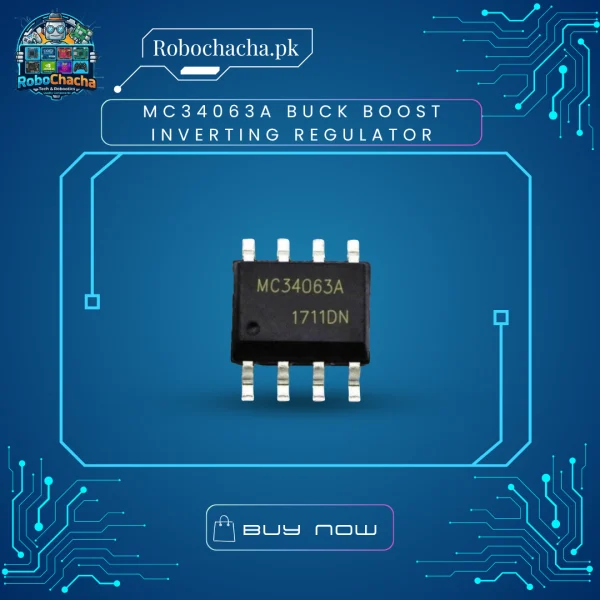
The MC34063A is a monolithic control circuit containing the primary functions required for DC-to-DC converters. While most modules are locked into being either “Buck” or “Boost,” the MC34063A architecture allows it to be configured in three distinct ways: Step-Up (Boost), Step-Down (Buck), and Voltage-Inverting. For hobbyists and engineers, it is most commonly used to create a negative power rail from a single positive battery source, making it indispensable for dual-supply analog projects.
Key Features
3-in-1 Versatility: One chip/module can handle buck, boost, or inverting configurations depending on the external circuit.
Inverting Capability: Easily generates a negative voltage (e.g., -5V, -12V) from a positive input.
Wide Input Range: Operates reliably from 3V up to 40V.
Current Limiting: Built-in cycle-by-cycle current limiting to protect your sensitive components.
Precision Reference: Features a 1.25% internal reference for stable output.
Technical Specifications
Feature
Specification
Input Voltage
3.0V to 40V DC
Output Current
1.5A (Peak)
Output Voltage
Adjustable (Positive or Negative)
Switching Frequency
Up to 100 kHz
Internal Reference
1.25V
Operating Temperature
0°C to 70°C
Common Use Cases
Negative Voltage Rails: Essential for Dual-Rail Op-Amps ($\pm 12V$ or $\pm 5V$).
LCD Contrast Circuits: Providing the negative bias required for some older or industrial character LCDs.
Battery-Powered Instrumentation: Getting a higher or negative voltage from a single Li-ion cell.
RS232 Communication: Generating the positive and negative voltages required for serial data signals.
Weight
2000 g
Dimensions
15 × 10 × 5 cm
Reviews
There are no reviews yet.
Be the first to review “MC34063A Buck Boost Inverting Regulator Module – Universal DC-DC Converter (Step-Up/Down/Negative Voltage) in Pakistan”Cancel Reply



Reviews
There are no reviews yet.